
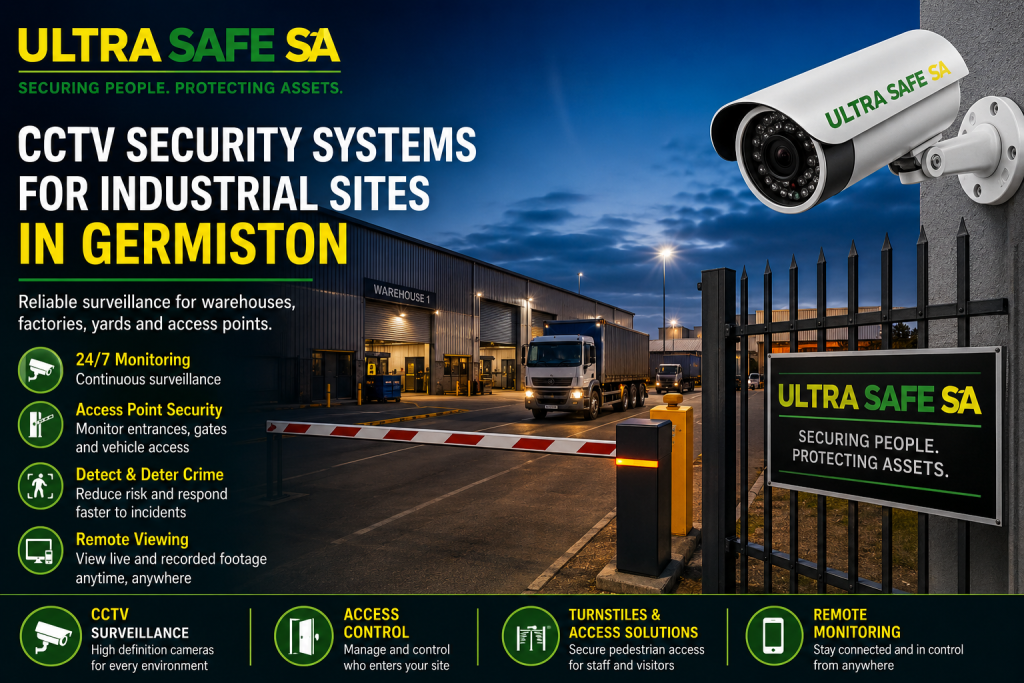
CCTV Security Systems for Industrial Sites in Germiston
CCTV Security Systems for Industrial Sites in Germiston
Industrial properties in Germiston face unique security challenges. Large warehouses, manufacturing facilities, vehicle yards, loading areas and storage spaces can cover extensive areas, making it difficult for security personnel to monitor every section of a property at all times.
A professional CCTV security system in Germiston can provide continuous visual monitoring across important areas of an industrial site. When combined with access control and other security measures, CCTV gives businesses greater visibility over what is happening on their premises and helps security teams respond more effectively to suspicious activity.
Ultra Safe SA provides security solutions designed to help businesses improve protection and monitoring across commercial and industrial environments.
Why Industrial Properties Need Professional CCTV
Industrial sites often contain valuable equipment, vehicles, stock, machinery and materials. They may also have multiple entrances, delivery areas and perimeter access points.
Traditional security patrols remain important, but guards cannot be physically present everywhere simultaneously. CCTV provides an additional layer of protection by allowing designated areas to be monitored continuously.
Strategically positioned cameras can monitor:
- Main entrances and exits
- Vehicle gates and access points
- Loading and unloading areas
- Warehouses and storage facilities
- Parking areas
- Perimeter sections
- Offices and restricted areas
- Equipment and machinery yards
- Delivery areas
This gives security personnel a clearer overview of activity across the property.
CCTV for Germiston Warehouses and Factories
Warehouses and factories often have large open spaces where security vulnerabilities can be difficult to identify.
A professionally designed CCTV system can help reduce these blind spots by positioning cameras according to the layout and security requirements of the property.
For example, cameras can be installed to monitor warehouse entrances while additional units cover loading bays and vehicle movement around the exterior.
The objective is not simply to install as many cameras as possible. Instead, the system should provide useful coverage of the areas where security incidents are most likely to occur.
Monitoring Vehicle Movement
Industrial properties often experience regular vehicle traffic from employees, contractors, suppliers and delivery companies.
CCTV can provide valuable visibility around vehicle entrances and exits.
Security personnel can monitor:
- Vehicles entering and leaving the property
- Delivery activity
- Unusual vehicle behaviour
- Congestion around entrance points
- Activity after normal operating hours
- Incidents occurring near gates or parking areas
When CCTV is combined with an appropriate access control system, businesses can create a more comprehensive approach to vehicle and personnel security.
Combining CCTV With Access Control
CCTV is most effective when it forms part of a wider security strategy.
For industrial properties, surveillance cameras can complement access control and turnstile systems, helping businesses manage both physical entry and visual monitoring.
Access control determines who is permitted to enter specific areas, while CCTV provides a visual record of activity around those access points.
For example, a business could use access control at an employee entrance while CCTV monitors the entrance and surrounding area.
This combination can help security personnel investigate unusual activity and maintain better awareness of what is happening across the site.
Protecting Industrial Perimeters
Large industrial properties can have extensive perimeter fencing, multiple access points and areas that receive little activity during certain parts of the day.
These locations can become potential security vulnerabilities if they are not adequately monitored.
CCTV can be positioned at strategic points around the property to provide visibility of vulnerable sections.
Camera placement should take into consideration:
- Fence lines
- Corners and blind spots
- Vehicle entrances
- Pedestrian access points
- Dark or poorly monitored areas
- Valuable outdoor equipment
- Areas behind warehouses and buildings
A professional site assessment can help determine where surveillance coverage is most valuable.
CCTV for Night-Time Security
Industrial properties do not stop requiring protection when employees leave for the day.
In fact, after-hours security can be particularly important for warehouses, factories and equipment yards.
Suitable CCTV equipment can provide surveillance during low-light conditions, depending on the camera technology selected and the property’s lighting environment.
Security teams can use the footage to monitor activity after normal working hours and investigate incidents that occur overnight.
The right camera specification should be selected according to the property’s lighting, viewing distances and environmental conditions.
Choosing the Right CCTV Cameras
Not every industrial property requires the same type of CCTV equipment.
The appropriate camera depends on where it will be installed and what it needs to monitor.
Important considerations include:
Camera Location
A camera monitoring a small doorway has very different requirements from one covering a large vehicle yard.
The viewing distance, angle and area that needs to be monitored should be considered before selecting equipment.
Image Quality
Clear images are important when reviewing incidents or identifying activity.
Higher-resolution cameras may be appropriate for areas where detailed visual information is required.
Night-Time Visibility
Outdoor industrial environments may have limited lighting after hours. Cameras should therefore be selected according to the available lighting and the level of nighttime visibility required.
Weather Resistance
Outdoor cameras must be capable of operating in the environmental conditions where they are installed.
Suitable equipment and professional installation can help improve long-term reliability.
Storage and Recording
Businesses should also consider how footage will be stored, how long it needs to be retained and who should have access to recorded footage.
These decisions should form part of the overall CCTV system design.
Reducing Security Blind Spots
One of the biggest advantages of professional CCTV planning is the ability to identify areas that may otherwise go unnoticed.
Simply installing cameras at obvious locations does not guarantee complete coverage.
A professional assessment can identify:
- Areas hidden behind buildings
- Poorly monitored entrances
- Vehicle yard blind spots
- Perimeter gaps
- Dark sections of the property
- Restricted areas requiring additional surveillance
The goal is to create a surveillance network that works with the physical layout of the site rather than installing equipment without considering the property’s specific requirements.
CCTV as Part of a Complete Security Strategy
CCTV should not necessarily be viewed as a standalone security solution.
For industrial sites, it can form part of a broader system incorporating:
- CCTV surveillance
- Access control
- Turnstiles
- Vehicle access management
- Alarm systems
- Physical security measures
- Professional security monitoring
Each component addresses a different part of the security process.
CCTV provides visibility. Access control manages authorised entry. Physical security measures help protect the perimeter. Together, these technologies can create a stronger and more organised security environment.
Frequently Asked Questions
Is CCTV suitable for large industrial properties?
Yes. CCTV can be designed to monitor large industrial properties, including warehouses, factories, vehicle yards, entrances and perimeter areas. Camera positioning and equipment selection are important for achieving effective coverage.
Can CCTV monitor vehicle entrances?
Yes. Cameras can be positioned around vehicle entrances and exits to provide visual monitoring of vehicle activity.
Can CCTV work with access control?
CCTV and access control can be used together as part of an integrated security strategy. This allows businesses to combine controlled access with visual surveillance.
Do industrial CCTV cameras work at night?
Suitable CCTV equipment can provide surveillance in low-light and nighttime environments. The correct camera should be selected based on the property’s lighting and monitoring requirements.
How many cameras does an industrial site need?
There is no standard number. The required number depends on the size and layout of the property, the number of entrances, perimeter requirements, viewing distances and areas that require monitoring.
Improve Your Industrial Site Security in Germiston
Protecting an industrial property requires more than simply installing cameras at the main entrance. A properly planned CCTV system should consider the entire property, from vehicle gates and loading areas to warehouses, parking areas and perimeter zones.
For businesses looking for CCTV security systems in Germiston, Ultra Safe SA can help assess the security requirements of the property and identify suitable surveillance and access control solutions.
With professional CCTV positioned around important areas, businesses can improve visibility, support security personnel and create a stronger layer of protection for valuable property and assets.
Ready to improve your industrial site’s security? Contact Ultra Safe SA to discuss a CCTV and access control solution designed around your Germiston property.